 Mexida
Push-ups for beginners: 5 steps, from the wall to the floor
Can't do a push-up? Start against a wall. The 5 push-up steps, how to do each one and when to move on to the next, without rushing.
Can't do a push-up on the floor? It's more common than you'd think, and it's no reason to give up. A push-up isn't all or nothing: there are easier versions that train the same muscles and get you to the floor, step by step.
In this guide you'll see how to do a push-up with good form, the 5 steps from the wall to a full push-up, and when it makes sense to move on to the next one.
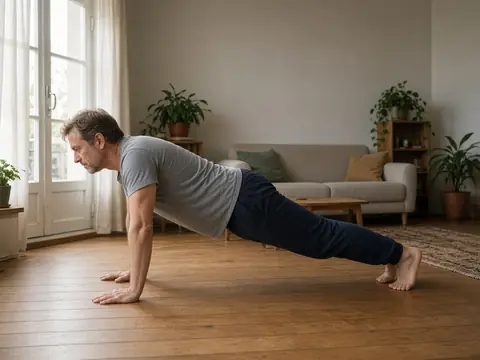
How to do a push-up properly
Whatever the version, the form points are the same:
- Hands slightly wider than your shoulders, at chest height.
- Body in a straight line, from head to feet (or knees). Don't let your hips sag or stick up.
- Tummy and glutes tight, so your body moves as one block.
- Elbows pointing slightly back, not flared out to the sides.
- Lower yourself with control until you're close to the surface, then push back up.
- Breathe: in on the way down, out on the way up.
The push-up mainly works the chest, shoulders and the back of the arms, and also needs core strength to keep your body straight.
The 5 steps, from easiest to hardest
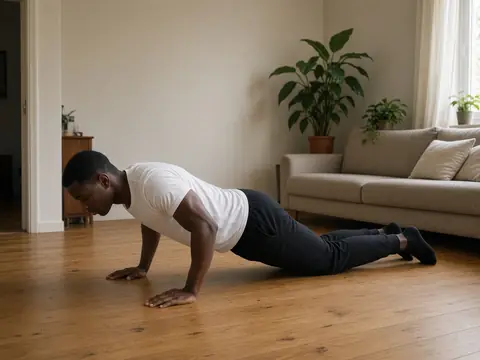
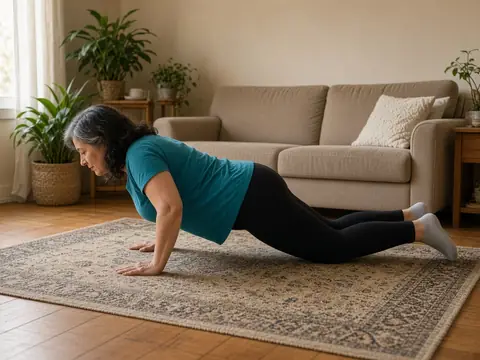
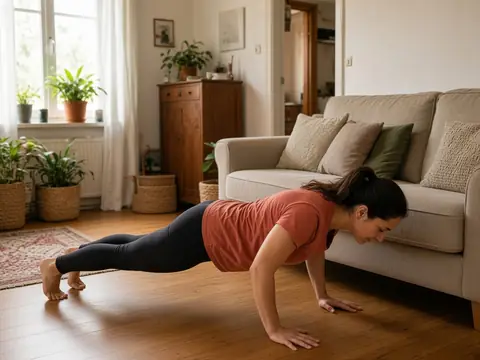
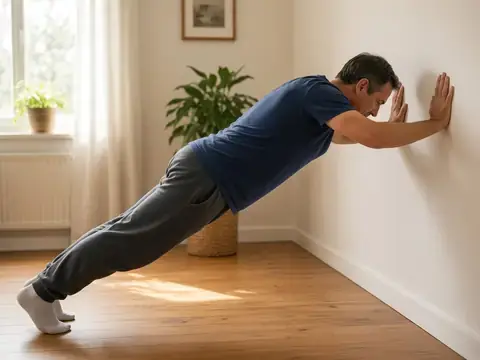
1. Wall push-up
Stand an arm's length from a wall, hands on the wall at chest height. Keeping your back straight, bend your arms, bring your chest towards the wall and push back slowly. The NHS suggests this version with 3 sets of 5 to 10 reps [1]. To make it a bit harder, step your feet further from the wall.
2. Knee push-up
On the floor, resting on your knees (a mat or towel helps). Your body stays in a straight line from knees to head. Lower until your chest is close to the floor and push back up.
3. Slow knee push-up
The same knee push-up, but lowering over about 3 seconds. Going down slowly gives your muscles more time under effort and helps you control the movement.
4. Negative push-up
In the full push-up position (on your hands and toes), lower yourself very slowly, over 3 to 5 seconds, to the floor. Then drop to your knees to come back up. You're training the lowering part, which is usually the first to get strong.
5. Full push-up
On your hands and toes, body straight, lower and push up. Once you get here, the goal becomes doing more reps with good form, not doing them fast.
When to move on to the next step
The rule is the same for every step: move on once the current one feels comfortable. You do the reps you planned with good form, without pain, and still had one or two left.
- Change only one thing at a time.
- Don't rush. It's normal to stay on the same step for several weeks.
- On a new step, if your form gets worse, go back to the previous one for a few more workouts. It's not going backwards, it's preparing.
Everyone moves at their own pace, and there's no set deadline for reaching a full push-up.
As for how many to do: to start, 2 to 3 sets of a few good reps, 2 to 3 times a week with a rest day in between, fits the WHO recommendation for muscle strengthening on at least 2 days a week [2].
Common mistakes
- Hips sagging or sticking up too high: tighten your tummy and glutes.
- Elbows flared wide, in a "T": bring them a little closer to your body.
- Head dropping: look at the floor slightly in front of your hands.
- Short, fast reps: go for fewer reps, with full range and control.
- Skipping steps: if your form can't hold, that version is still too hard.
Frequently asked questions
How many push-ups should a beginner do?
There's no right number for everyone. Start with 2 to 3 sets of a few reps, in the version you can do well, and build up gradually.
Do wall push-ups work?
They're a lighter version of the same movement and a way to start training your chest, shoulders and arms [1]. When they get easy, move on to knee push-ups.
Can I do push-ups every day?
When you're starting out, it's simpler to train 2 to 3 times a week with rest in between. If you have pain, stop and talk to a health professional.
Do knee push-ups "count"?
They do. They work the same muscles with less load, and they're a normal step on the way to a full push-up.
Before you start
This article is general information and doesn't replace health advice. If you have pain (for example in your shoulders, wrists or back), an injury or a health condition, if you're pregnant or if you haven't exercised in a long time, talk to a health professional first. If an exercise causes pain, stop.
A plan that tells you which step you're on
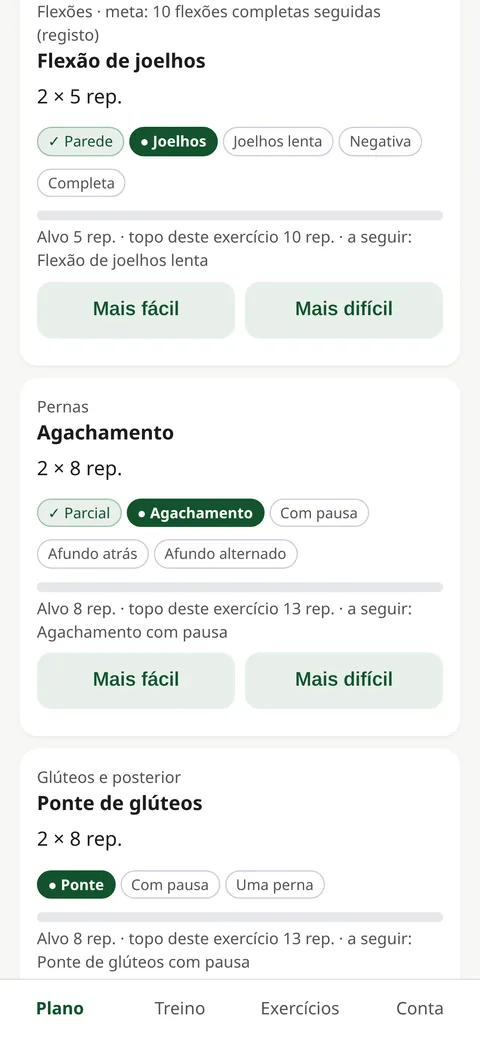
These are the same 5 steps we use in Mexida, a home calisthenics app we're building. You start at your level and the app adjusts your workout based on how you say it went. The app isn't out yet. If you'd like to know when it opens, join the waitlist: mexida.com.
Read next: Calisthenics for beginners: how to start at home.
Sources
- NHS, Strength exercises ("Wall press-up": 3 sets of 5 to 10 reps). https://www.nhs.uk/live-well/exercise/strength-exercises/
- World Health Organization, WHO guidelines on physical activity and sedentary behaviour (2020). https://www.who.int/publications/i/item/9789240015128
Accessed 28/10/2026.