 Mexida
Calisthenics for beginners: how to start at home, no equipment
What calisthenics is, which exercises to start with and how to plan your week at home, with no equipment. A simple guide, at your own pace.
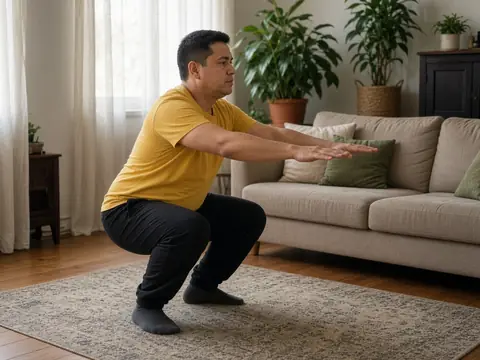
Want to start working out at home but not sure where to begin? Calisthenics is a good way in. You don't need a gym, machines or anything new to get started. Just your body, a bit of floor and a few minutes.
This guide explains what calisthenics is, which exercises to do at the start and how to plan your week. No magic promises: just what you can actually do, at your own pace.
What is calisthenics
Calisthenics means training with your own body weight. Push-ups, squats, planks and bridges are all calisthenics exercises. Later on, some people add a bar for pull-ups, but that's optional and you don't need it to start.
The big advantage is that every exercise has easier and harder versions. If you can't do a push-up on the floor yet, you do it against a wall. If a full squat is hard, you go halfway down. You start where you are today, not where you think you "should" be.
How much to train: what the WHO says
The World Health Organization recommends that adults (18 to 64) do at least 150 to 300 minutes of moderate aerobic activity a week, or 75 to 150 minutes of vigorous activity. It also recommends muscle-strengthening activities that work the major muscle groups on at least 2 days a week [1].
There's one important message for anyone starting out: doing some physical activity is better than doing none, and if you're not active now, start small and build up gradually [1].
Calisthenics mostly covers the muscle-strengthening part. Walking, taking the stairs or cycling still count towards the aerobic part.
4 basic moves to get started
You don't need dozens of exercises to start. Four moves are enough to work your whole body.
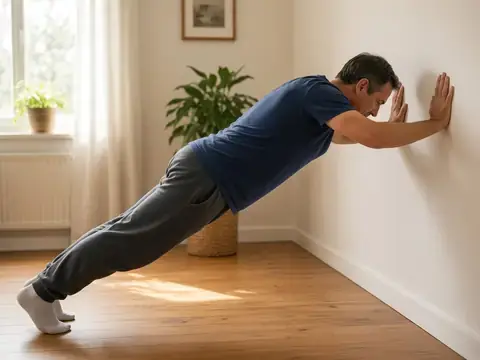
Push: push-up
Works your chest, shoulders and arms. If a floor push-up isn't happening yet, start against a wall: hands on the wall at chest height, body straight, bend your arms and push back. The NHS describes this version as a starting point, with 3 sets of 5 to 10 reps [2]. We have a whole guide on this: Push-ups for beginners.
Legs: squat
Feet shoulder-width apart, lower yourself as if you were sitting down on a chair, then stand back up. If it's hard, only go halfway, or put a real chair behind you as a guide.
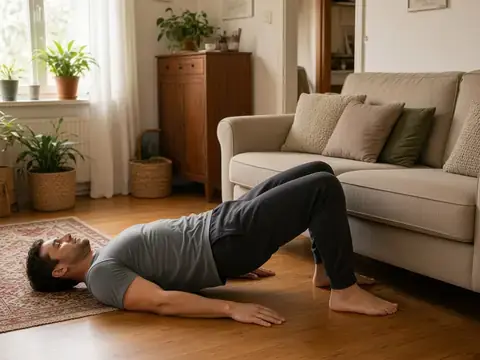
Hips: glute bridge
Lie on your back, knees bent and feet on the floor. Lift your hips until your body is in a line from knees to shoulders, hold for a second and lower slowly.
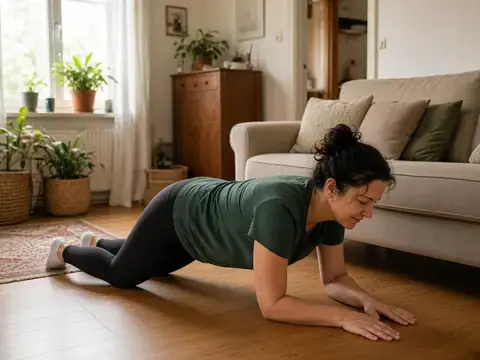
Core: plank
Forearms on the floor, body in a straight line from head to heels, tummy tight. If it's hard, rest on your knees. Start with a few seconds and build up slowly.
How to level up without rushing
The rule is simple: only move to the next version once the current one feels comfortable. You do your reps with good form, without pain, and feel you had one or two more left in you.
A few practical tips:
- Change one thing at a time: more reps, more seconds or a harder version, never all at once.
- Choose form over quantity. Five good reps beat fifteen rushed ones.
- Write down what you did. That way you know where you are and don't have to guess next time.
- Everyone progresses at their own pace. There's no set deadline for any exercise.
A sample first week
A simple example you can adapt:
- 2 to 3 days a week, with a rest day in between. Do the 4 moves: 2 sets of each, in the version you can do well, with about 40 seconds' rest between sets.
- Before: 2 to 3 minutes of warm-up (marching on the spot, arm circles, hip circles).
- After: 2 minutes of gentle stretching.
- On the other days: walk or move however you like.
That's about 15 minutes per workout. If you can't manage it one day, do less. Remember: a little counts.
Frequently asked questions
Is calisthenics OK if I've never trained?
Yes. Because every exercise has easier versions, you can start from zero. What matters is choosing the right version for you and moving up slowly.
Do I need equipment?
Not to start. A floor, a wall and, if you like, a mat. A bar can come later, but it's optional.
How many times a week should I train?
The WHO recommends muscle strengthening on at least 2 days a week [1]. To start, 2 to 3 short workouts with rest days in between is a good starting point.
How long until I see results?
There's no honest answer that fits everyone. It depends on many things, like your starting point, sleep, food and how regularly you train. Focus on training regularly and with good form.
Before you start
This article is general information and doesn't replace health advice. If you have pain, an injury or a health condition, if you're pregnant or if you haven't exercised in a long time, talk to a health professional first. If an exercise causes pain, stop.
Want a plan made for you?
We're building Mexida, a home calisthenics app: a 28-day plan, about 15 minutes a day, that starts at your level. The app isn't out yet. If you'd like to know when it opens, join the waitlist: mexida.com.
Sources
- World Health Organization, WHO guidelines on physical activity and sedentary behaviour (2020), recommendations for adults aged 18–64. https://www.who.int/publications/i/item/9789240015128
- NHS, Strength exercises ("Wall press-up"). https://www.nhs.uk/live-well/exercise/strength-exercises/
Accessed 28/10/2026.